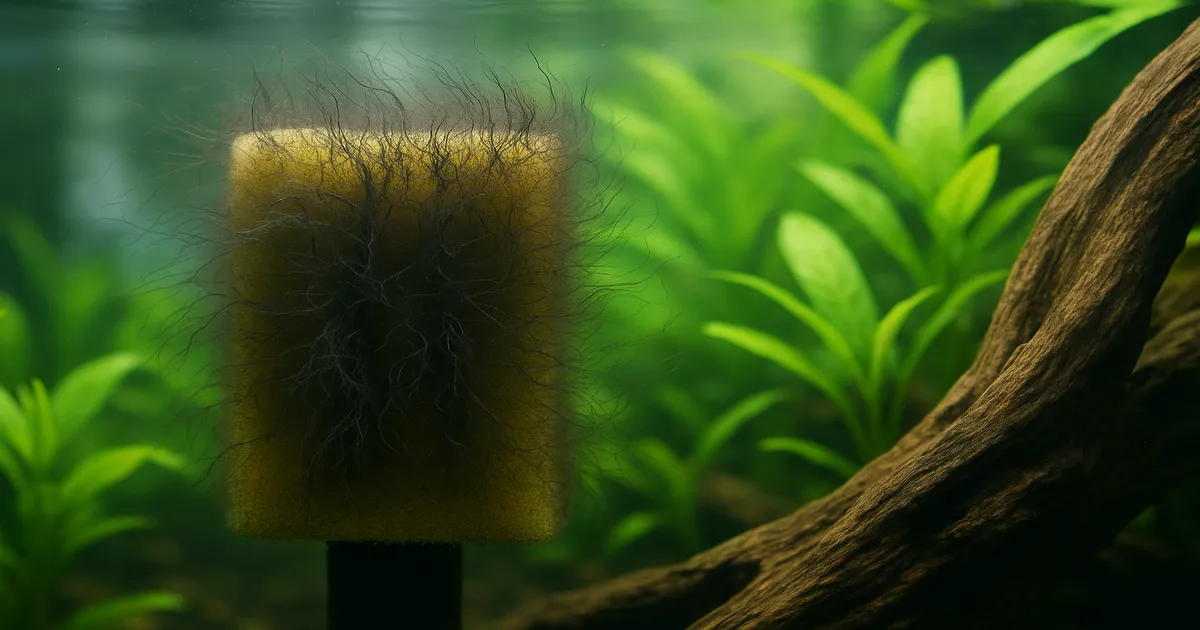
Quick Answer: That bushy growth on your aquarium filter is almost certainly Black Beard Algae (BBA) — a stubborn red algae that thrives in the high-flow, low-CO₂ microenvironment created by filter intakes and outputs. It looks dark grey to black, feels stiff and brush-like, and won’t disappear on its own. Stabilising your CO₂ levels and redirecting your filter output are the most effective long-term fixes.
So your filter is growing what looks like a tiny bush — dark, bristly tufts clinging to the intake, the spray bar, or the housing itself. You’re not imagining it, and you’re definitely not alone. This is one of the most common complaints in planted tank keeping, and the answer to why is my filter growing a bush almost always comes down to one thing: Black Beard Algae. Filters create a very specific set of conditions — high flow, fluctuating CO₂, rough plastic surfaces — and BBA is perfectly adapted to exploit every one of them.
What Is That Bushy Growth on Your Filter?
Black Beard Algae: The Most Likely Culprit
Despite its dark colour, BBA is actually a red algae belonging to the division Rhodophyta. It grows in dense, stiff tufts ranging from 2 to 15 mm long, appearing anywhere from dark grey to nearly black depending on your lighting. The “beard” or “bush” description fits it perfectly.
It colonises filter hardware aggressively because filters create exactly what BBA loves: high water flow, fluctuating CO₂, organic debris, and rough plastic surfaces to grip onto.
Quick confirmation trick: Dip a small piece of affected material into dilute bleach. BBA turns red or pink — revealing its true nature as a red algae — while hair algae simply dissolves.
Other Possible Causes at a Glance
Before you treat anything, make sure you’ve correctly identified what you’re dealing with.
| Growth Type | Colour | Texture | Smell | Flow Preference |
|---|---|---|---|---|
| Black Beard Algae | Dark grey/black | Stiff, brush-like | Mild | High flow |
| Hair Algae | Bright green | Soft, stringy | Mild | Low–medium flow |
| Staghorn Algae | Grey/silver | Stiff, branching | Mild | Medium flow |
| Cyanobacteria | Blue-green/teal | Slimy, sheet-like | Strong, musty | Low flow |
| Java Moss / Plant | Bright green | Soft, branching fronds | None | Any |
Hair algae is soft and stringy — it floats in the current and pulls off in long threads. Staghorn algae is stiffer and grey, branching like antlers. Both respond better to blackout treatments than BBA does, which is one reason correct identification matters before you start treating.
Cyanobacteria forms slimy sheets rather than tufts and has a distinctive musty, earthy smell that BBA lacks. It also prefers low-flow zones, so finding it on a filter intake would be unusual.
Actual plants: Occasionally a fragment of Java moss or a stem cutting gets sucked against an intake and takes root. Unlike algae, it will be bright green with visible branching structure. If your tank has floating plants or moss, check whether what you’re seeing is a plant volunteering to colonise your hardware.
Why Is My Filter Growing a Bush? The Real Causes
CO₂ Fluctuation at the Intake
Water rushing into a filter intake creates localised turbulence that degasses dissolved CO₂ from the surrounding water. The result is a tiny pocket of low-CO₂ water right at the intake — which is exactly where BBA sets up camp. Spray bars pointed upward or breaking the water surface make this worse, aerating the tank and stripping CO₂ at the same time.
Nutrient Accumulation on Filter Surfaces
Filter sponges and housings trap detritus — uneaten food, fish waste, plant debris. That organic matter breaks down into phosphate and nitrate, which feeds the algae growing on the outside of the housing just inches away. Your filter isn’t just catching waste; it’s potentially fertilising the algae attached to it.
Rough Plastic Surfaces
Smooth glass is far less hospitable to algae than the textured plastic of most filter housings and intakes. Rough surfaces give BBA filaments something to anchor into, which is why it clings so stubbornly to plastic and wipes off glass much more easily.
Water Parameters: What Triggers Bushy Filter Algae
CO₂: The Single Most Important Factor
Fluctuating or low dissolved CO₂ is the primary driver of BBA. In CO₂-injected tanks, the most common trigger is CO₂ switching off at night. Plants stop consuming CO₂ when the lights go out, parameters shift, and that daily swing gives BBA a foothold. Target 20–30 mg/L consistently and monitor with a drop checker using a 4 dKH reference solution — lime green is the target colour.
Set your CO₂ timer to switch on one hour before lights on and off one hour before lights out. Place your diffuser near the filter intake so CO₂-rich water gets distributed throughout the tank efficiently.
Nitrate, Phosphate, and Other Parameters
BBA gains a significant advantage when nitrates climb above 20–40 ppm or phosphate exceeds 1.0–2.0 ppm. Keep nitrate in the 5–20 ppm range and phosphate between 0.1–1.0 ppm. Test weekly during an outbreak with a reliable liquid test kit .
High KH (above 6 dKH) makes it harder to maintain stable dissolved CO₂, which indirectly worsens BBA. Most tropical tanks run at 74–80°F (23–27°C) — which is also the sweet spot where BBA is most problematic.
| Parameter | Ideal Range |
|---|---|
| pH | 6.5–7.2 |
| GH | 4–8 dGH |
| KH | 3–6 dKH |
| Temperature | 74–78°F (23–26°C) |
| CO₂ | 20–30 mg/L |
| Nitrate | 5–20 ppm |
| Phosphate | 0.1–1.0 ppm |
| Ammonia / Nitrite | 0 ppm |
Tank Setup Changes That Prevent Filter Algae
Redirect your filter output. Point your spray bar horizontally or angled downward below the water surface. This maintains circulation without the surface agitation that drives off CO₂. It’s the simplest, highest-impact change you can make.
Adjust your lighting. Non-CO₂ tanks should run 6–8 hours per day; CO₂-injected tanks 8–10 hours. High-intensity lighting without adequate CO₂ is a fast track to BBA — light drives photosynthesis, which consumes CO₂, and if CO₂ can’t keep up, algae wins. A midday siesta (lights off for 2–3 hours mid-photoperiod) can reduce algae advantage without stressing plants.
Balance your flow rate. Aim for 5–10× your tank volume per hour in a planted tank. Too little flow creates nutrient-rich dead spots; too much causes excessive CO₂ degassing. Even, gentle circulation is the goal.
Consider a surface skimmer. A surface skimmer removes the oily surface film and keeps the water clear without the aggressive agitation of a spray bar. It’s a low-agitation alternative that works well in CO₂-injected tanks where preserving dissolved CO₂ is a priority.
Biological Controls: Fish and Invertebrates That Eat Bushy Algae
True Siamese Algae Eaters (Crossocheilus oblongus) are the gold standard for BBA control. They’ll actively graze on BBA in a way almost no other fish will. The key word is true SAE — the Flying Fox (Epalzeorhynchos kalopterus) looks similar but is largely ineffective and more aggressive. Keep SAEs in groups of 3–6; they’re bolder and more active in numbers.
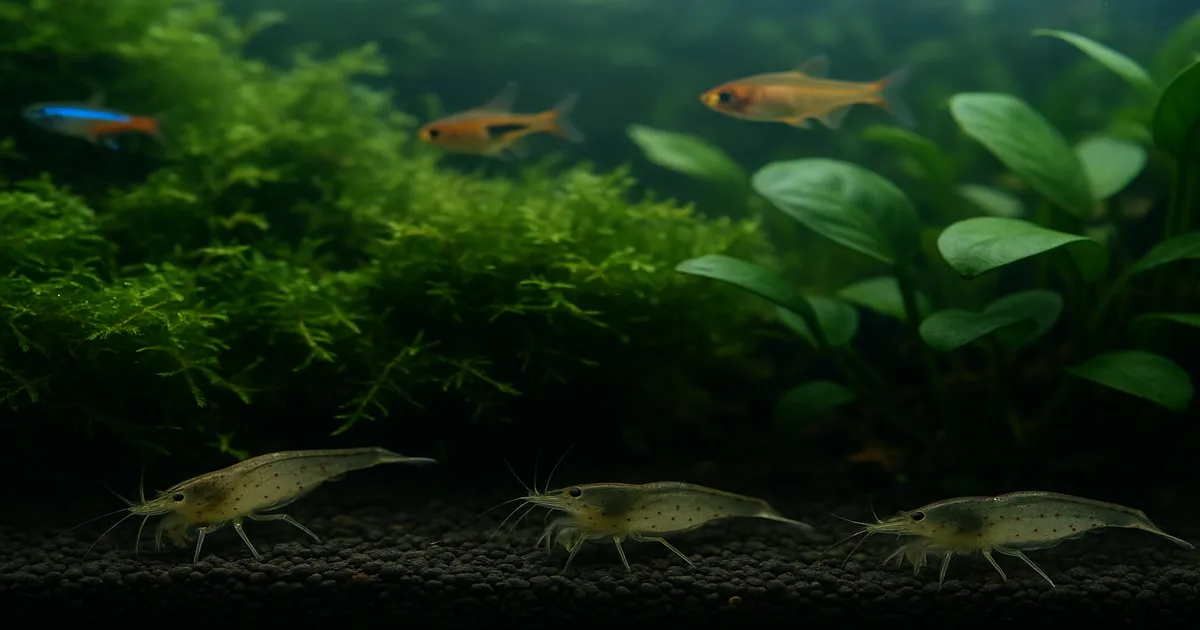
Amano shrimp (Caridina multidentata) are excellent BBA grazers, but only in numbers. A single shrimp will hide and accomplish nothing. A group of 10 or more will visibly work through BBA, especially after it’s been pre-treated with liquid carbon and turned red — at that point it becomes far more palatable to them. Don’t keep Amanos with angelfish, large cichlids, or any fish large enough to view them as a snack.
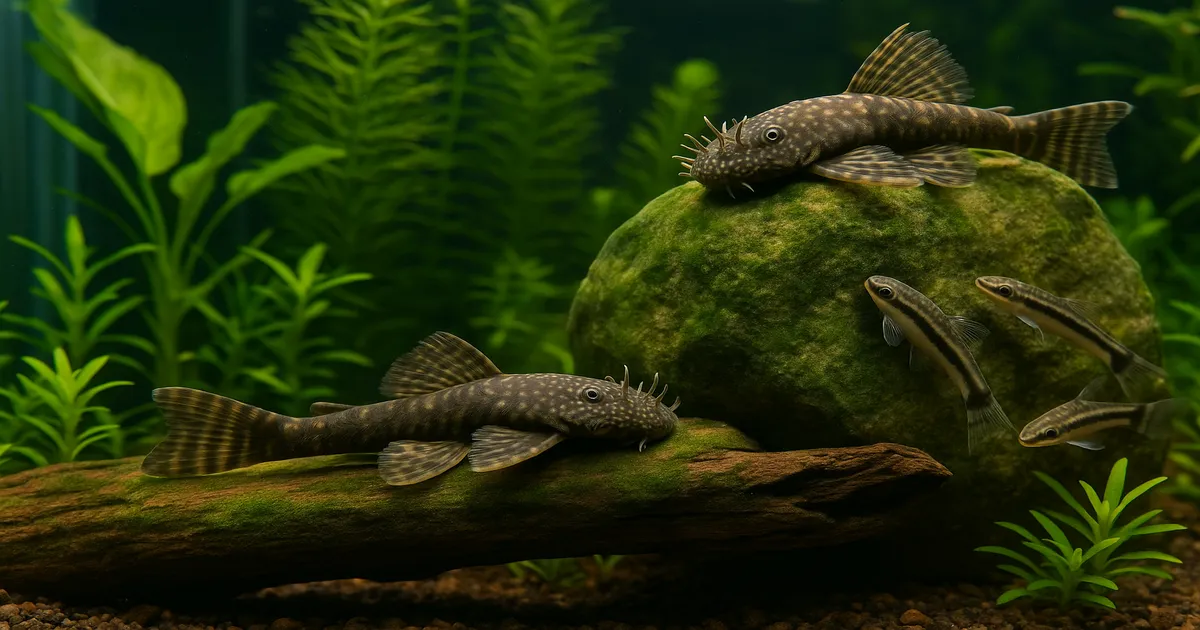
Bristlenose plecos (Ancistrus spp.) will graze BBA from hard surfaces and produce far less waste than common plecos. Otocinclus are better suited to preventing soft algae than tackling established BBA, but they’re a solid part of a clean-up crew. Keep them in groups of at least 6 — they’re a schooling species and fare poorly alone, and they need pristine, stable water.
Avoid common plecos (Pterygoplichthys spp.) — they grow enormous and produce enough waste to fuel the algae they’re supposed to eat. Adult Chinese Algae Eaters are effective when young but become territorial and aggressive. Mystery snails and nerite snails are great for other algae types but largely useless against BBA.
How to Remove Bushy Algae from Your Filter
Liquid Carbon Spot Treatment
This is the most popular and effective treatment for BBA on filter hardware and plants.
- Turn off your filter completely
- Draw undiluted liquid carbon into a syringe (Seachem Excel)
- Apply directly to the affected area
- Wait 5–10 minutes, then restart the filter
- Repeat daily for 2–4 weeks
Within 24–48 hours, treated BBA turns red or pink — confirmation it’s dying. Shrimp and SAEs will often eat it at this stage. Use caution around mosses, liverworts, and Vallisneria, which are sensitive to glutaraldehyde.
Bleach Dip for Removable Hardware
- Mix 1 part unscented household bleach with 19 parts water (approximately 5% bleach solution)
- Submerge the hardware for 2–3 minutes
- Rinse thoroughly with dechlorinated water
- Neutralise with a dechlorinator before returning to the tank (Seachem Prime)
Do not use this on live plants unless treating extremely hardy species like Anubias, and even then limit exposure to 1–2 minutes.
Hydrogen Peroxide Treatment
3% pharmaceutical-grade hydrogen peroxide is gentler than bleach and safer for plants and shrimp. Soak removed hardware in 3% H₂O₂ for 5–10 minutes, then rinse thoroughly. For in-tank spot treatment, apply undiluted via syringe with the filter off, exactly as you would with liquid carbon.
Manual Removal
Scrubbing BBA with an old toothbrush works, but it’s rarely sufficient alone. BBA leaves behind attachment filaments capable of regrowing. Always siphon out the debris immediately after scrubbing to prevent it from settling and reattaching elsewhere. Combine manual removal with a chemical treatment for best results.
The Long-Term Fix: Stable CO₂
Every treatment above kills existing BBA. None of them prevent it from coming back if the underlying cause — fluctuating or insufficient CO₂ — isn’t addressed. Raise dissolved CO₂ to 25–30 mg/L consistently, redirect your spray bar, and set your CO₂ timer correctly. Within 2–4 weeks, new growth should stop and existing colonies will begin to die back.
Maintenance Habits That Keep Filter Algae Away
Don’t overfeed. Every pinch of uneaten food eventually becomes nitrate and phosphate — which feeds the algae on your filter housing. Feed only what your fish consume in 2–3 minutes, once or twice daily. Remove uneaten food with a turkey baster within 5 minutes of feeding, and fast your fish one day per week.
Clean your filter monthly using old tank water, never tap water. Tap water kills the beneficial bacteria in your media. Rinse sponges gently — you want to remove trapped detritus, not strip the biological colonisation.
Do weekly water changes of 30–50%. This dilutes nitrates, phosphates, and organic waste before they accumulate to levels that fuel algae. It’s unglamorous, but it’s one of the most effective long-term algae prevention strategies available.
Dose fertilisers carefully. Use lean dosing matched to your plant mass and avoid overdosing phosphate-containing all-in-one fertilisers. Only dose phosphate-specific fertilisers if your test reads zero — deficiency is rare in most tanks.
Frequently Asked Questions
Why is my filter growing a bush — what exactly is it?
Almost certainly Black Beard Algae (BBA), a red algae (Rhodophyta) that appears dark grey to black despite its classification. It grows in stiff, brush-like tufts 2–15 mm long and strongly favours the high-flow, low-CO₂ microenvironments created by filter intakes and outputs. Dip a small piece in dilute bleach — BBA turns red or pink, confirming the identification.
How do I get rid of bushy algae on my filter intake?
The most effective approach combines daily spot treatment with undiluted liquid carbon (applied via syringe with the filter off) and long-term CO₂ correction to address the root cause. For removable plastic parts, a bleach dip (1:19 bleach-to-water, 2–3 minutes) kills BBA on contact. Add Siamese Algae Eaters or a large group of Amano shrimp to clean up dying colonies. Repeat spot treatments daily for 2–4 weeks.
Why does algae keep coming back on my filter no matter what I do?
Because the root cause — fluctuating or insufficient dissolved CO₂ — hasn’t been fixed. Killing existing BBA without correcting CO₂ levels, redirecting your spray bar, and managing nutrients is like bailing a boat without plugging the hole. Fix the CO₂ consistency first, and the regrowth cycle will stop.
Is the bushy growth on my filter harmful to my fish?
BBA itself is not toxic to fish and won’t directly harm them. However, a heavy BBA outbreak is a symptom of an imbalanced tank — poor CO₂ stability, elevated nutrients, or inadequate maintenance — and those underlying conditions can stress fish over time. Treat the algae as a warning sign and address the root causes rather than just the visible growth.
Can I prevent BBA without CO₂ injection?
Yes, though it’s harder. In non-CO₂ tanks, keep lighting to 6–8 hours per day, avoid overfeeding, perform weekly water changes, and maintain a healthy population of fast-growing plants to outcompete algae for nutrients. Liquid carbon (Seachem Excel) used as a regular additive can also help suppress BBA in low-tech setups, though it’s less effective than full CO₂ injection.