Quick Answer: Most community tanks need 1.5–2 inches of gravel, planted tanks need 2–3 inches of nutrient-rich soil, and tanks housing burrowing species need 2–3 inches of fine sand. Use the formula Length × Width × Desired Depth ÷ 10 (all measurements in inches) to estimate pounds of gravel needed. Substrate type, livestock, and tank purpose all change the answer significantly.
Figuring out how much substrate you need to buy is one of those setup questions that seems simple until you realize gravel, sand, and planted soil all calculate differently. The wrong depth can affect fish health, water chemistry, and plant growth. This guide walks you through the math, the depth recommendations, and the species-specific details so you buy the right amount the first time.
How Much Substrate Do You Need? Quick Depth Guide
Starting Depths by Tank Type
For most tanks, these depths are a reliable starting point:
- Community tanks (gravel): 1.5–2 inches
- Planted tanks (soil): 2–3 inches
- Burrowing species (fine sand): 2–3 inches
- Marine FOWLR: 0.5–1 inch
- Marine Deep Sand Bed (DSB): 4–6 inches
The basic formula for gravel or sand is L (inches) × W (inches) × Depth (inches) ÷ 10 = approximate pounds needed. See the calculation section below for the full breakdown, including metric conversions and substrate-specific factors.
When to Deviate From Standard Depth
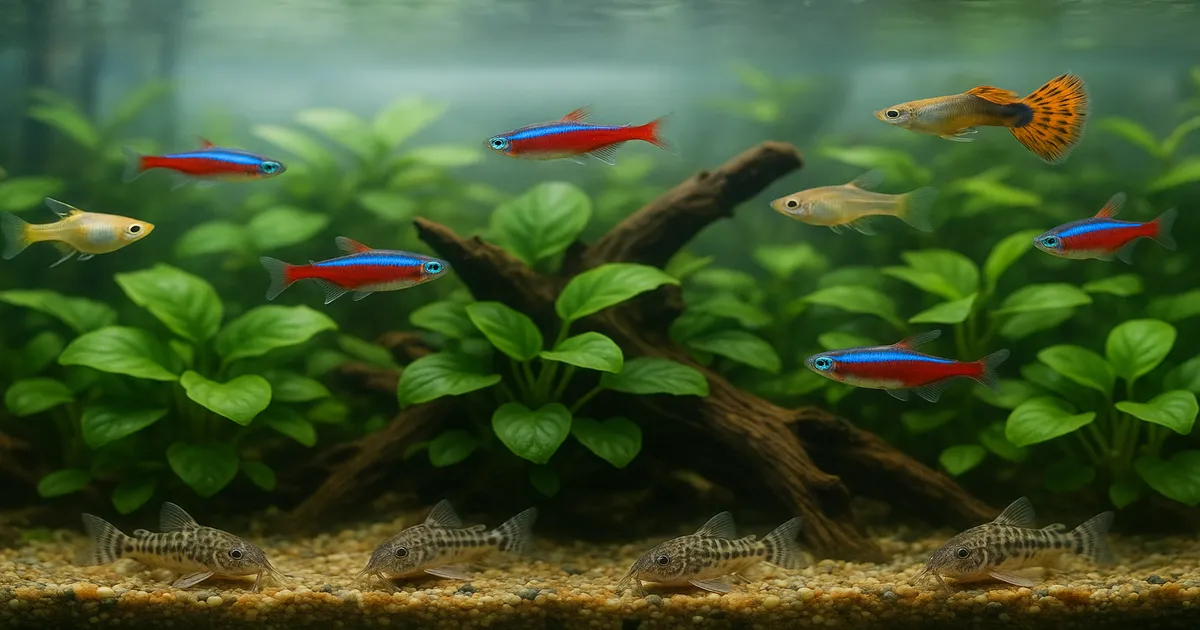
Your livestock and tank goals matter more than any rule of thumb. Corydoras need at least 2 inches of fine sand — coarse gravel erodes their barbels over time. Planted tanks with heavy root feeders like Amazon swords benefit from a full 3 inches of soil. Marine DSBs are intentionally deep (4–6 inches) to create the anaerobic zones that drive denitrification. Think of the standard depth as a starting point, not a universal answer.
How to Calculate How Much Substrate to Buy
The Imperial Formula (Pounds of Gravel or Sand)
L (inches) × W (inches) × Depth (inches) ÷ Conversion Factor = Pounds of Substrate
For a 55-gallon tank (48” × 13”) with 2 inches of gravel: 48 × 13 × 2 ÷ 10 = ~125 lbs
Use ÷ 10 for standard gravel. For sand, use ÷ 10–12 — sand is denser, so you need slightly less volume to reach the same depth, but it weighs more per cubic inch.
The Metric Formula (Litres of Substrate)
L (cm) × W (cm) × D (cm) ÷ 1,000 = Volume in Litres
For a 60 cm × 30 cm tank with 5 cm of substrate: 60 × 30 × 5 ÷ 1,000 = 9 litres
This lines up neatly with how most planted substrate brands package their product. ADA Aqua Soil Amazonia, for example, covers roughly 1 inch of depth in a standard 60 cm tank per 9 L bag.
Conversion Factors by Substrate Type
| Substrate Type | Imperial Divisor | Notes |
|---|---|---|
| Standard gravel | ÷ 10 | Most common starting point |
| Play sand / pool filter sand | ÷ 10–12 | Denser; verify by weight |
| Planted soil (Fluval Stratum, ADA) | Check bag coverage | Manufacturer specs vary |
| Aragonite / crushed coral | ÷ 10 | Similar density to gravel |
Always cross-check your calculation against the manufacturer’s bag coverage spec. A bag labelled for a 20-gallon tank at 1 inch may not match your tank’s exact footprint.
Using Online Substrate Calculators
If you’d rather skip the math, both Aquarium Co-Op and CaribSea offer free online substrate calculators that factor in tank dimensions and substrate type. They’re especially useful for oddly shaped tanks or specialty substrates with unusual densities.
Recommended Substrate Depth by Tank Type
General Community Tanks (Gravel)
1.5–2 inches is the sweet spot for a standard community setup. It’s enough depth to support a healthy colony of nitrifying bacteria in the substrate’s interstitial spaces without going so deep that you risk anaerobic dead zones. Anything under an inch provides minimal biological benefit and looks sparse.
Planted Tanks and Capped Substrate Systems
Planted tanks need 2–3 inches of nutrient-rich substrate to support root systems. For heavy root feeders, lean toward 3 inches. Many aquascapers use a capped system: 1–1.5 inches of soil topped with 1 inch of fine sand or gravel to prevent the soil from clouding the water column. Fluval Stratum and ADA Aqua Soil are the most widely used options for this approach.
Burrowing Fish: Corydoras, Loaches, and Stingrays
These species need 2–3 inches of fine sand — not just for comfort, but for natural behaviour. Corydoras sift through sand to find food; Kuhli loaches bury themselves completely. Freshwater stingrays (Potamotrygon spp.) need a minimum of 3–4 inches of fine sand and very large tanks (150+ gallons) to thrive. Sharp gravel causes barbel erosion in Corydoras that is often mistaken for bacterial infection — and once the barbels are damaged, they rarely fully recover.
African Cichlid and Rift Lake Tanks
Mbuna, Aulonocara, and Tropheus all come from hard, alkaline water. Use 2–3 inches of aragonite or crushed coral sand, which slowly dissolves to buffer pH to 7.8–8.5, raise GH to 10–20 dGH, and KH to 10–20 dKH. This substrate does double duty — it maintains the water chemistry these fish require while providing a natural-looking environment.
Marine FOWLR vs. Deep Sand Bed (DSB) Systems
In a fish-only-with-live-rock (FOWLR) tank, 0.5–1 inch of substrate is purely aesthetic — the live rock handles biological filtration. A DSB is a completely different approach. Four to six inches of fine aragonite sand creates a deliberate anaerobic zone where bacteria convert nitrate to nitrogen gas, providing passive denitrification. This is one of the few cases where deep substrate is not just safe but actively beneficial.
Shrimp Tanks
1.5–2 inches works well for shrimp. The more important question is which substrate. Neocaridina shrimp (cherry shrimp) do fine on inert substrates at pH 6.5–7.5, GH 6–12, KH 2–8. Caridina shrimp (Crystal Red, Crystal Black) need a buffering substrate that actively lowers pH to 5.8–6.8, GH to 4–6, and keeps KH at 0–2 — requirements that plain gravel simply cannot meet.
Bare-Bottom Tanks: When No Substrate Is the Right Answer
Bare-bottom setups make the most sense for discus (which need pristine water and frequent cleaning), quarantine tanks, and breeding setups where fry survival depends on easy food access and hygiene. They’re also far easier to treat during disease outbreaks, since parasites like ich have nowhere to hide. The trade-off is reduced biological filtration capacity and a less natural appearance.
Substrate Amount by Tank Size: Weight Reference Table
| Tank Size | Footprint | 1” Gravel | 2” Gravel | 3” Gravel |
|---|---|---|---|---|
| 10 gallon | 20” × 10” | ~14 lbs | ~28 lbs | ~42 lbs |
| 20 gallon long | 30” × 12” | ~25 lbs | ~50 lbs | ~75 lbs |
| 40 gallon breeder | 36” × 18” | ~45 lbs | ~90 lbs | ~135 lbs |
| 55 gallon | 48” × 13” | ~43 lbs | ~86 lbs | ~130 lbs |
| 75 gallon | 48” × 18” | ~60 lbs | ~120 lbs | ~180 lbs |
Figures are approximate for standard gravel (specific gravity ~1.5). Sand runs heavier per volume.
A 55-gallon tank already holds around 460 lbs of water. Add 86 lbs of gravel and you’re pushing 550 lbs before accounting for the tank itself, equipment, and decor. Always verify your stand’s rated capacity — and on upper floors or older construction, check that the floor can handle the concentrated load.
How Substrate Type Affects Water Chemistry
Inert Substrates: Gravel, Plain Sand, and Glass Beads
Inert substrates have no chemical effect on pH, GH, or KH. Your water chemistry will reflect whatever comes out of your tap, which is actually an advantage if you want full control through water changes and targeted additives. Suitable for most community fish, Neocaridina shrimp, and species that tolerate pH 6.5–8.0.
Aragonite and Crushed Coral: Raising pH and Hardness
Aragonite and crushed coral dissolve slowly, releasing calcium carbonate that buffers pH to 7.8–8.5, raises GH to 10–25 dGH, and KH to 10–20 dKH. Essential for African cichlid tanks, livebearers, and brackish setups. Don’t use them with soft-water species — the chemistry mismatch causes chronic stress.
Buffering and Acidic Substrates: ADA Aqua Soil, Fluval Stratum, and Similar
These substrates release humic acids that actively lower pH to 5.5–6.8 and keep KH near zero. They’re essential for Caridina shrimp, cardinal tetras, Apistogramma, and discus. The soft, slightly acidic water they produce mimics the blackwater and clearwater rivers these species come from. Most buffering substrates last 12–18 months before their pH-lowering effect fades; after that, pH will drift toward your tap water’s natural level and the substrate will need replacing or supplementing.
Species-Specific Substrate Requirements
Corydoras and Kuhli Loaches: Fine Sand Is Non-Negotiable
Corydoras have sensory barbels that they use to forage through substrate. Sharp gravel erodes these barbels, leaving them vulnerable to bacterial infection. Pool filter sand or CaribSea Super Naturals at 2+ inches is the correct choice. Kuhli loaches share the same requirement and will burrow completely into fine sand — that’s entirely normal behaviour, not a cause for concern.
Geophagus and Substrate-Sifting Cichlids
Geophagus (“earth eater”) cichlids scoop mouthfuls of substrate, pass it through their gill rakers to extract invertebrates, and spit out the rest. They need at least 3 inches of fine sand. Gravel particles are too large and can damage their delicate gill tissue.
Crystal Red Shrimp and Caridina Species
Caridina shrimp are among the most parameter-sensitive freshwater invertebrates in the hobby. They require a buffering substrate that maintains pH 5.8–6.8, GH 4–6, and KH 0–2. At 1.5–2 inches depth, Fluval Stratum and SL-Aqua substrates provide enough buffering capacity while keeping the tank manageable.
Marine Species: Jawfish, Wrasses, and Mandarin Dragonets
Jawfish need 4–6 inches of mixed substrate — fine sand plus small rubble — to construct and maintain their burrows. Most wrasse species sleep buried in sand and need at least 2–3 inches to do so safely. Mandarin dragonets require live sand teeming with copepods; a DSB system is the most reliable way to sustain the copepod populations they depend on.
Substrate Maintenance and Health Risks
Hydrogen Sulfide in Deep Freshwater Substrate
In freshwater tanks, substrate deeper than 3–4 inches can develop anaerobic pockets where bacteria produce hydrogen sulfide (H₂S) — a toxic gas that smells like rotten eggs. Disturbing these layers during a deep gravel vacuum can release a pulse of H₂S into the water column, causing sudden fish deaths. Regular, gentle vacuuming prevents the substrate from becoming fully compacted and anaerobic.
Mulm Buildup and Ammonia Spikes
Decomposing fish waste, uneaten food, and plant debris accumulate in substrate over time. This mulm releases ammonia, which stresses fish and makes them susceptible to fin rot (Aeromonas and Pseudomonas spp.) and columnaris (Flavobacterium columnare). Regular gravel vacuuming during water changes is the single most effective prevention. A quality gravel vacuum makes this task significantly easier. (Python No Spill Clean and Fill)
Ich and the Substrate Connection
Ich (Ichthyophthirius multifiliis) has a substrate-dwelling resting stage called a tomont. These cysts embed in the substrate and hatch into free-swimming theronts that reinfect fish — which is why treating only the fish while leaving the substrate untouched rarely eliminates an outbreak. Raising temperature to 86°F (30°C) speeds up the parasite’s life cycle and makes treatments more effective. Bare-bottom quarantine tanks eliminate the hiding spots entirely.
How to Vacuum Different Substrate Types
Gravel tanks: Use a gravel vacuum during every water change. Work in sections — vacuuming the entire bed at once removes too much beneficial bacteria. Avoid pushing the tube all the way to the bottom in deep substrate.
Fine sand tanks: Hover the vacuum just above the surface rather than plunging it in. Gentle stirring once a month prevents compaction without triggering H₂S release.
Marine DSBs: Do not vacuum the sand bed. You’ll destroy the bacterial stratification that makes denitrification work. Rely instead on a healthy cleanup crew — nassarius snails, sand-sifting starfish, and cerith snails — to keep the surface oxygenated.
Frequently Asked Questions
How much substrate do I need for a 10-gallon tank? For a standard 10-gallon tank (20” × 10”), plan on roughly 14 lbs of gravel for 1 inch of depth, or 28 lbs for 2 inches. If you’re using fine sand, buy slightly less by volume — sand is denser and will weigh more for the same depth.
Can I mix gravel and sand in the same tank? Yes, but they tend to separate over time as fish activity and water movement cause the finer sand to settle beneath the gravel. Many aquarists use dividers or slope the substrate to keep zones distinct. A capped planted substrate (soil beneath, sand on top) is a common and effective version of this approach.
How often should I replace my substrate? Inert substrates like gravel and plain sand last indefinitely — they don’t need replacing unless you want a change of look. Active buffering substrates (ADA Aqua Soil, Fluval Stratum) typically exhaust their buffering capacity in 12–18 months and should be replaced if you’re keeping pH-sensitive species like Caridina shrimp.
Does more substrate mean better biological filtration? Up to a point, yes. More substrate surface area means more space for nitrifying bacteria. However, substrate deeper than 3–4 inches in freshwater tanks risks anaerobic dead zones that produce hydrogen sulfide. For most tanks, 2 inches of gravel strikes the right balance between filtration benefit and safety.
What’s the best substrate for a beginner community tank? Plain pea gravel or a medium-grade aquarium gravel at 1.5–2 inches is the most forgiving choice. It’s inert (won’t shift your water chemistry), easy to vacuum, compatible with most filters, and inexpensive. Once you know what fish you want to keep long-term, you can upgrade to a species-appropriate substrate.