Quick Answer: The most common worms in planted tanks are detritus worms (harmless, caused by overfeeding), planaria (a moderate threat to shrimp and fry), and Camallanus worms (a serious internal parasite requiring immediate treatment). Identify the worm first — most are either a maintenance signal or a simple removal job, but Camallanus demands urgent action for every fish in the tank.
Spotting something wriggling in your aquarium and asking “what is this worm in my planted tank?” is one of the most common panicked searches in the hobby — and for good reason. Some of these creatures are completely harmless. Others will kill your shrimp colony or hollow out your fish from the inside. Knowing which one you’re dealing with changes everything.
Quick Identification: What Is This Worm in My Planted Tank?
At-a-Glance Identification Table
| Worm | Appearance | Movement | Location | Threat Level |
|---|---|---|---|---|
| Detritus worms | Thread-like, white to pale pink, 1–10 mm | Rapid wriggling | Substrate, water column | ✅ None — maintenance signal |
| Planaria | Flat, arrow-headed, white/brown, 3–15 mm | Smooth gliding | Glass, substrate, surfaces | ⚠️ Moderate — threatens shrimp, fry, eggs |
| Blackworms | Dark, segmented, 2–10 cm | Fast coiling | Substrate | ✅ None — likely leftover live food |
| Horsehair worms | Hair-like, dark brown/black, 10–100 cm | Slow writhing tangle | Open water | ✅ None — remove with net |
| Camallanus | Red/orange threads at fish vent, 5–20 mm visible | Protrudes from fish | Fish body (anal vent) | 🚨 Serious — treat entire tank immediately |
| Bloodworms | Bright red, segmented, 1–3 cm | Looping, figure-eight | Substrate | ✅ Low — great fish food, won’t establish |
| Hydra | Tubular with tentacles, 1–20 mm, white/green | Extends/retracts | Glass, plants, hardscape | ⚠️ Dangerous to fry and shrimp |
Harmless vs. Harmful: How to Prioritise Your Response
If red threads are visibly protruding from your fish’s vent, skip the table and jump straight to the Camallanus section — that’s your emergency. Tiny white threads wriggling out of the substrate? Almost certainly detritus worms, and the fix is a feeding reduction plus a good gravel vacuum. Everything else falls somewhere in between.
Identifying Every Worm Type Found in Planted Tanks
Planaria (Flatworms): Arrow-Headed Gliders
Planaria are true flatworms (phylum Platyhelminthes) and unmistakable once you know what to look for. They have a distinctly flat, spade-shaped head with two dark eyespots that give them a permanently cross-eyed appearance. White planaria (Stenostomum spp.) are smaller and more translucent; brown planaria (Dugesia spp.) are larger and opaque, typically 3–15 mm long.
Movement is the other giveaway. Planaria glide smoothly across surfaces — glass, substrate, plant leaves — using cilia on their underside. They don’t wriggle or thrash. They cruise. You’ll most often spot them on the glass at night or first thing in the morning before the lights come on, since they’re strongly photophobic. They enter tanks by hitchhiking on live plants, driftwood, rocks, or in the water from a fish bag.
Detritus Worms (Naididae/Tubificidae): Thread-Like Substrate Dwellers
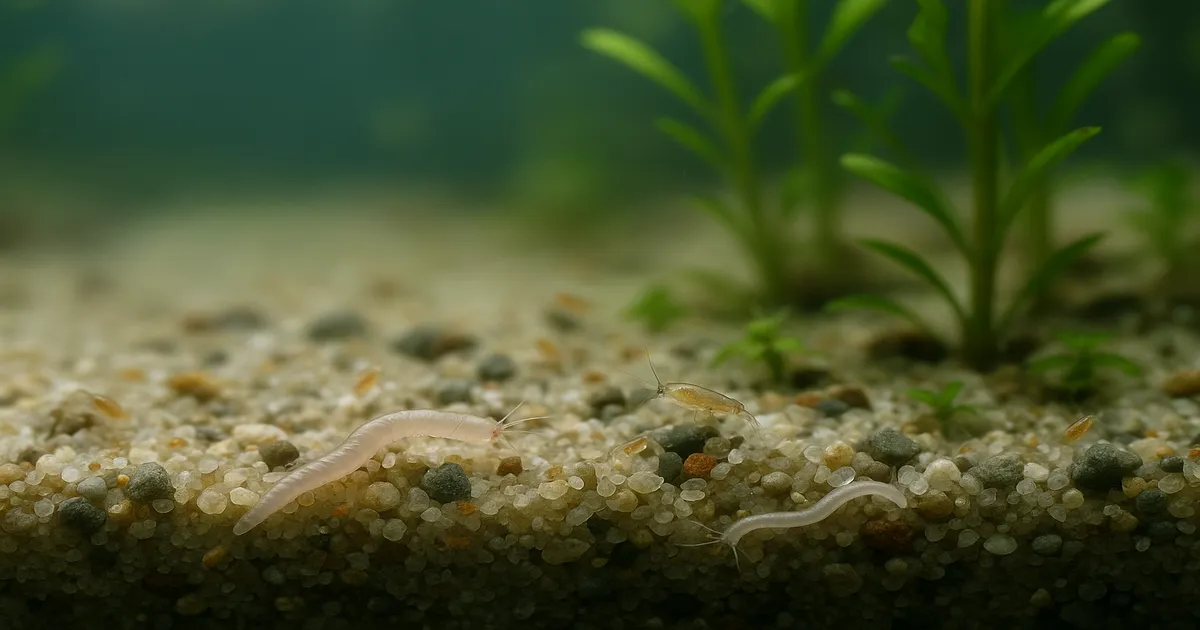
These are the worms most hobbyists encounter first. Detritus worms are annelids — segmented worms related to earthworms — from the families Naididae and Tubificidae. They’re extremely thin, pale white to pinkish, and typically only 1–10 mm long. Under a light, they look like tiny threads of cotton.
Their movement is a frantic, thrashing wriggle — completely unlike the gliding of planaria. You’ll see them poking out of the substrate or swimming erratically in the water column, especially after a water change disturbs the gravel. They thrive wherever there’s excess organic waste.
Blackworms (Lumbriculus variegatus): Dark, Segmented, and Coiling
If you’ve recently fed live food, this is your most likely culprit. Blackworms are noticeably larger than detritus worms — dark brown to black, clearly segmented, and up to 10 cm long. They move in rapid, coiling bursts and are substantially thicker-bodied than any detritus worm. They almost never establish breeding populations in warm tropical tanks because they prefer cool, well-oxygenated water (ideally below 65°F/18°C). Finding one just means a few survivors burrowed into the substrate after feeding.
Horsehair / Gordian Worms (Nematomorpha): The Alarming Hair-Like Tangle
Few aquarium discoveries are as alarming as finding what looks like a long tangle of dark hair writhing in your tank. Horsehair worms can reach 10–100 cm and are extraordinarily thin — like a strand of hair with a mind of its own. They move in slow, coiling, knotted loops that look almost mechanical. They enter your tank inside feeder insects — crickets and mealworms commonly carry them. The worm exits the host after it’s consumed by your fish, then ends up free in the water. They cannot parasitize fish or humans. Fish one out with a net and move on.
Camallanus Worms: Red Threads Protruding from Fish
This one isn’t in the substrate or on the glass — it’s coming out of your fish. Camallanus worms (Camallanus cotti is the most common hobby species) are internal nematode parasites that protrude visibly from the fish’s anal vent as red to orange-red threads, with 5–20 mm visible externally. The internal portion is longer. Affected fish often show weight loss, lethargy, and a pinched belly before the worms become visible. Livebearers, bettas, and gouramis are especially susceptible. These worms arrive with infected fish from stores or breeders — quarantine is the only reliable prevention.
Bloodworms (Chironomid Larvae): Bright Red Loopers in the Substrate
The vivid crimson colour is the immediate identifier. Bloodworms are the larvae of non-biting midges (Chironomus spp.) and they get their colour from actual haemoglobin — rare in insects. They’re 1–3 cm long, clearly segmented, and move in a distinctive looping or figure-eight motion through the substrate. They occasionally enter tanks when adult midges lay eggs in open aquariums, or they arrive as live fish food. Your fish will likely eat them before you even notice them.
Hydra: The Tentacled Impostor Often Mistaken for a Worm
Hydra isn’t a worm at all — it’s a cnidarian, related to jellyfish and sea anemones. Its tubular body and waving tentacles get it misidentified constantly. Look for a small (1–20 mm) stalk attached to the glass, plants, or hardscape, with 5–12 tentacles extending outward. It doesn’t move across surfaces; it stays fixed and extends or retracts its tentacles to capture prey. Hydra arrives on live plants, snails, or in bag water. Harmless to adult fish, but genuinely dangerous to anything small.
Are These Worms Dangerous? Threat Assessment
No Threat: Detritus Worms, Blackworms, and Horsehair Worms
Detritus worms are biological indicators, not predators. Their presence signals too much food or not enough vacuuming — but they won’t harm a single fish or shrimp. Blackworms are essentially free fish food. Horsehair worms are biologically incapable of parasitizing vertebrates; once they’re in the water column, they’re stranded and harmless.
Moderate Threat: Planaria and Their Impact on Shrimp and Fry
Healthy adult fish have nothing to fear from planaria. The real victims are eggs, newborn fry, and dwarf shrimp — particularly Neocaridina and Caridina species. Planaria are active predators of small, slow, or immobile prey, and a population explosion in a shrimp tank can devastate a colony fast. If you keep shrimp, planaria demand a response.
Serious Threat: Camallanus Worms
Camallanus is the one worm in this guide that routinely kills healthy adult fish. It damages the intestinal tract, causes malnutrition, and in heavy infections leads to death. The critical point: every fish in the infected tank must be treated, not just the ones showing visible worms. Fish that look fine are likely already infected. The whole tank is compromised the moment one fish shows symptoms.
Hidden Danger: Hydra and Small Livestock
Hydra’s tentacles carry nematocysts — stinging cells — that can immobilise and kill anything small enough to be captured. Shrimp fry under 1 cm, fish fry of any species, and juvenile invertebrates are all at serious risk. In a fry-rearing tank or breeding shrimp setup, hydra is a genuine emergency.
Why Worms Appear: Conditions That Fuel Outbreaks
Overfeeding is the single biggest driver of detritus worm and planaria outbreaks. Uneaten food decomposes into organic sludge, which is exactly what these organisms eat and breed in. Ask yourself whether your fish are cleaning up every meal within two minutes.
Elevated nitrates are a reliable early warning sign. Detritus worm populations explode when nitrates climb above 40 ppm; planaria correlate with high organic load and ammonia spikes. Keeping nitrates below 20 ppm through regular water changes removes a key resource these organisms depend on. A liquid test kit makes tracking this straightforward — the API Freshwater Master Test Kit covers all the parameters you need.
Substrate depth matters too. Fine substrates like ADA Aqua Soil trap detritus more readily than coarse gravel, and deep beds over 2 inches develop anaerobic pockets ideal for detritus worms. Keeping substrate depth to 1–1.5 inches with weekly vacuuming dramatically reduces this habitat.
How worms enter the tank:
- Planaria and Hydra: Hitchhike on live plants, rocks, snails, and fish-bag water
- Camallanus: Arrives with infected fish — quarantine every new fish for at least four weeks
- Detritus worms: Arrive with live plants or live food, then multiply if conditions allow
- Horsehair worms: Enter via infected feeder insects (crickets and mealworms are the most common vectors)
- Bloodworms: Enter through open tank tops when adult midges lay eggs in the water
How to Get Rid of Worms in a Planted Tank
Detritus Worms: Fix the Root Cause
No chemicals needed. The fix is mechanical and behavioural:
- Reduce feeding — feed only what fish consume in two minutes, once or twice daily
- Vacuum the substrate thoroughly during your next water change
- Rinse filter media in old tank water (never tap water) to clear worm colonies building up in the media
- Test your water — if ammonia or nitrite are detectable, address the cycle before anything else
The population will crash once you remove their food source.
Planaria: Traps, Manual Removal, and Chemical Treatment
The dark trap method exploits planaria’s photophobia. After lights-out, place a small piece of raw meat or shrimp inside a dedicated planaria trap on the substrate. Retrieve and discard before lights come on. Repeat nightly.
For heavier infestations, chemical treatment is more reliable:
- Fenbendazole (e.g., Panacur C ) dosed at approximately 1 mg/L; effective but toxic to snails and other molluscs — remove them before treatment
- No-Planaria / Benibachi — a commercial betel nut palm extract widely used in shrimp tanks; follow label dosing carefully and watch shrimp for stress
Both treatments require removing activated carbon from your filter for the duration.
Camallanus Worms: Treating the Entire Tank
Remove activated carbon before starting. Treat every fish in the tank, not just the symptomatic ones.
- Levamisole hydrochloride is the primary treatment, typically dosed at around 10 mg/L. Perform a large water change after 24–48 hours, then repeat the full dose after two weeks to catch newly hatched worms
- Fenbendazole can follow as a secondary treatment to address remaining larvae
- Some fish will visibly expel worms during treatment — this is normal and a sign the medication is working
- Do not share nets, siphons, or any equipment with other tanks until the infection is fully resolved
Bloodworms: Let Your Fish Handle It
Your fish will almost certainly eat them before you need to intervene. If you want to remove them manually, a fine siphon during a water change works well. Long-term prevention is simple: keep your tank covered. A tight-fitting lid stops adult midges from laying eggs in the water.
Horsehair Worms: Net and Done
Net it out. There is no ongoing risk, no population to control, and no treatment required. The worm cannot reproduce in your tank.
Hydra: Heat, Chemicals, or Biological Control
- Heat treatment: Remove all fish to a holding tank, raise the temperature to 104°F (40°C) for two to three hours, then perform a large water change. Effective, but requires a separate vessel for livestock
- Fenbendazole: Dose at approximately 1 mg/L for 3–5 days; effective against hydra and generally safer for shrimp than heat, though snails must be removed first
- Biological control: Dwarf gourami (Trichogaster lalius) and honey gourami (Trichogaster chuna) actively hunt and eat hydra — the most hands-off long-term solution if your tank community allows it
Prevention: Tank Setup and Water Parameters
Good filtration is your first line of defence. A canister filter (Fluval 307) with fine mechanical media physically removes free-swimming larvae and keeps organic particles from settling. Target a flow rate of 5–10× your tank volume per hour, and rinse mechanical media in old tank water every two to four weeks — dirty media is a worm nursery.
Keep substrate depth to 1–1.5 inches in tanks prone to worm issues, and vacuum weekly in heavily stocked setups. Remove decaying leaves promptly — decomposing plant matter feeds worm populations just as overfeeding does.
Target water parameters to discourage worm populations:
- Ammonia and nitrite: 0 ppm, always
- Nitrate: Below 20 ppm — the single most controllable parameter tied to worm population size
- Temperature: Species-appropriate; staying above 82°F (28°C) passively suppresses planaria and hydra reproduction, since both prefer 65–77°F (18–25°C)
- pH and GH/KH: Optimise for your fish and plants; less critical for worm control directly
Biological Controls: Fish That Eat Aquarium Worms
Bettas are enthusiastic planaria hunters and will actively seek them out on the glass. Dwarf chain loaches (Ambastaia sidthimunki) and clown loaches (Chromobotia macracanthus) are highly effective at rooting planaria out of the substrate. Dwarf gourami and honey gourami are your best allies against hydra.
The catch: virtually all of these fish are incompatible with dwarf shrimp — the exact livestock that planaria and hydra threaten most. You’re often choosing between two risks, so weigh your stocking priorities carefully.
FAQ: What Is This Worm in My Planted Tank?
Q: Are the tiny white worms in my planted tank dangerous? Almost certainly not. Tiny white worms in the substrate or water column are almost always detritus worms — harmless annelids that signal excess organic waste. Reduce feeding, vacuum the substrate, and the population will crash on its own within a few weeks.
Q: Can worms in my aquarium harm my fish? Most cannot. Detritus worms, blackworms, horsehair worms, and bloodworms pose no threat to healthy fish. Planaria can harm eggs, fry, and dwarf shrimp. Camallanus worms are the serious exception — they are internal parasites that can kill adult fish and require immediate treatment of the entire tank.
Q: How do I tell the difference between planaria and detritus worms? Movement and shape. Planaria glide smoothly across surfaces and have a distinctive flat, arrow-shaped head with visible eyespots. Detritus worms thrash and wriggle frantically, are thread-thin with no visible head structure, and are usually seen poking out of the substrate or swimming erratically in the water column.
Q: Will my fish eat the worms in my tank? Often yes. Bettas, loaches, and gouramis actively hunt planaria. Most fish will eat bloodworms and detritus worms opportunistically. Camallanus worms, however, are internal parasites — fish cannot eat their way out of that infection, and medication is the only solution.
Q: How do I stop worms from coming back after treatment? Address the root cause. For detritus worms and planaria, that means reducing feeding, vacuuming the substrate regularly, and keeping nitrates below 20 ppm. For Camallanus, quarantine every new fish for at least four weeks before adding them to your display tank — that single habit eliminates the most common entry point.