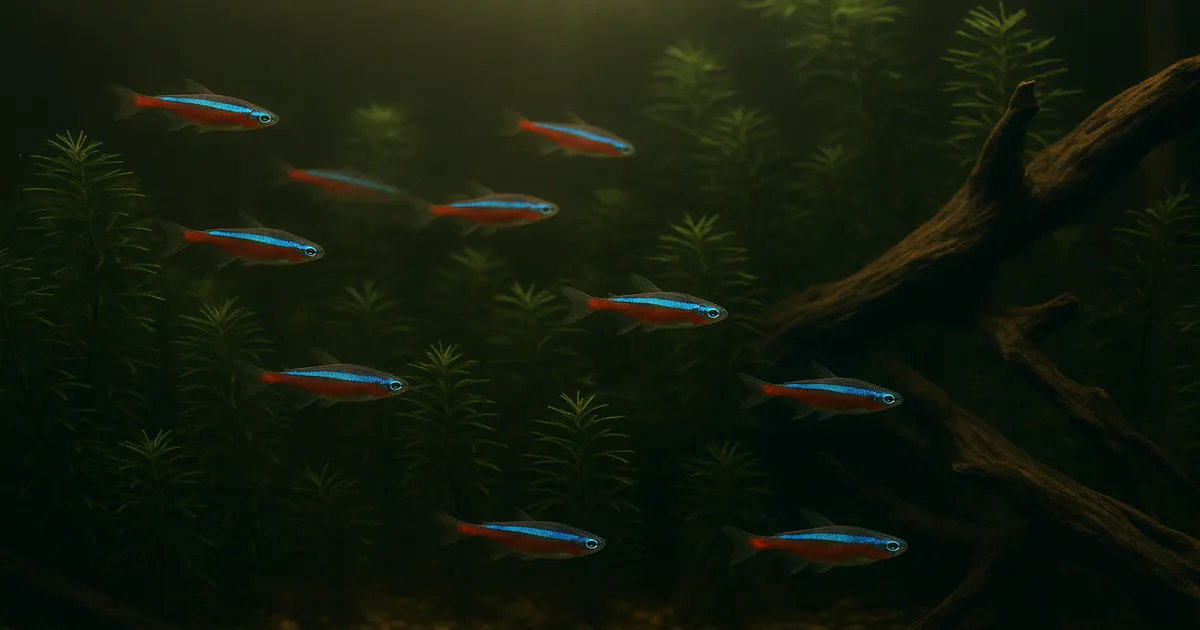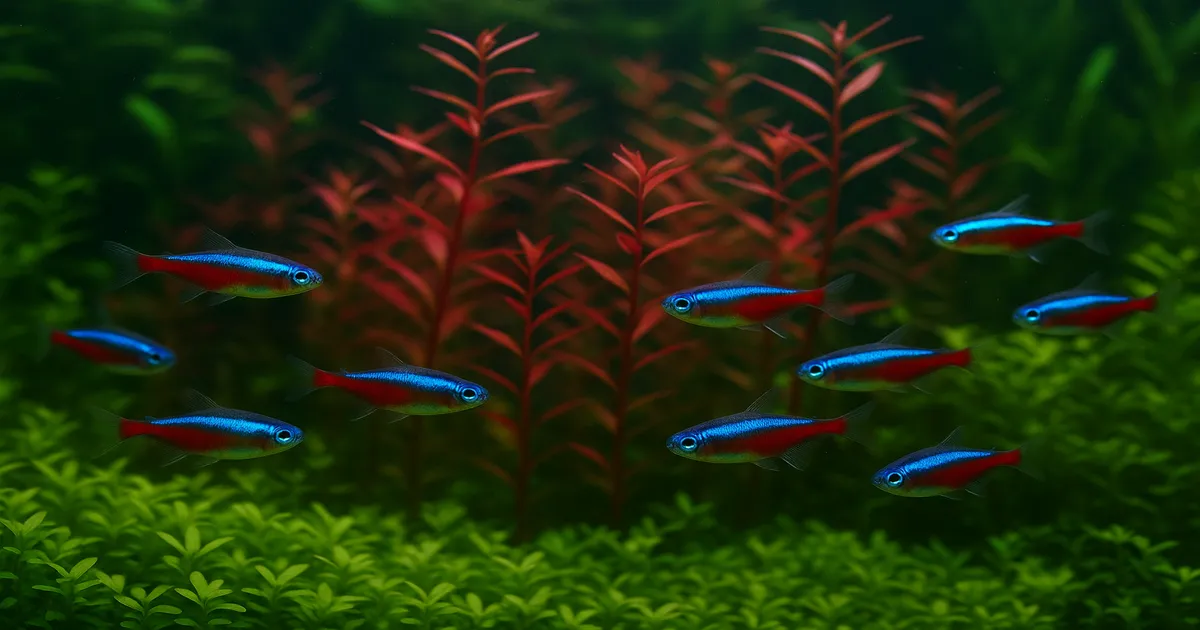
Quick Answer: Cardinal tetras turn dark almost always because of stress or illness. The most common culprits are poor water parameters (especially high pH, ammonia, or hard water), unsuitable tank conditions, a school that’s too small, a poor diet, or an underlying disease. In most cases the cause is identifiable and fixable — and with the right changes, vibrant colour can be fully restored.
If you’re asking “why are my cardinal tetras so dark?”, you’re already ahead of most fishkeepers — because colour change is one of the earliest warning signs these fish give you. Cardinal tetras (Paracheirodon axelrodi) are supposed to be stunning: a full-length iridescent blue-green stripe over a blazing red belly. When that fades to murky grey-brown, something in their environment or health is off. This guide works through every likely cause, in order of probability, so you can find the problem and fix it.
How Cardinal Tetra Colour Actually Works
Cardinal tetras produce their signature look through two types of specialised cells. Iridophores create the brilliant blue-green stripe through structural coloration — light bouncing off microscopic crystal plates inside the cells. The vivid red stripe below comes from chromatophores, which contain actual pigment.
Both cell types are under the fish’s direct physiological control. When everything is right — stable water, good food, a large school, a shaded tank — the cells expand and the colours pop. When something is wrong, the fish contracts its chromatophores almost instantly, and the colours collapse with them.
Think of it as an involuntary camouflage response. A stressed cardinal tetra pulls its pigment cells inward to reduce visibility to predators. In an aquarium, chronic stress — from bad water, bright lights, or a tiny school — keeps those cells contracted around the clock.
Brief darkening is completely normal. Fish darken at night and can look washed out for a few minutes after the lights come on. A newly introduced fish may also look dark for a day or two while it acclimates. Fish that stay dark all day, every day, are telling you something needs to change.
Why Are My Cardinal Tetras So Dark? Start With Water Parameters
Water chemistry is responsible for the majority of darkening cases, and it’s also the most fixable. Test in this order: ammonia → nitrite → nitrate → pH → GH → KH → temperature. Use a reliable liquid test kit rather than strips, which are notoriously inaccurate.
pH: the most common single cause
Cardinal tetras come from the Rio Negro — some of the most acidic water on the planet, with a pH as low as 4.0 in the wild. In captivity, slightly acidic water (pH 5.5–6.5) is optimal. Push above pH 7.5 and you have a significant, ongoing stressor that will show up as darkening, lethargy, and increased disease susceptibility.
Sudden swings are just as damaging as a consistently high pH. A shift of more than 0.3–0.5 units within 24 hours can cause acute stress and visible darkening within hours. Stability matters as much as the number itself.
Hardness: soft water is non-negotiable
These fish evolved in water with near-zero mineral content. Target 1–4 dGH and 0–2 dKH. If your tap water is hard — above 8–10 dGH — you’re asking cardinal tetras to live in water that’s fundamentally incompatible with their biology, and chronic colour loss is one of the first signs.
The fix is reverse osmosis (RO) water, blended with a small amount of tap water to reach target hardness, then remineralised with a soft-water supplement like Seachem Equilibrium at a low dose to restore the trace minerals fish still need.
Ammonia and nitrite: zero tolerance
There is no safe level of ammonia or nitrite for cardinal tetras. Even 0.25 ppm ammonia causes gill damage and visible darkening within hours. If your tank isn’t fully cycled, or if something has crashed your biological filter, this is almost certainly your problem. If you detect any ammonia or nitrite, do an immediate 30–50% water change and find the source before anything else.
Nitrate and temperature
Nitrate is less acutely toxic but still matters. Keep it below 20 ppm through regular water changes — below 10 ppm for a show-quality school. For temperature, the ideal range is 76–82°F (24–28°C). Below 72°F (22°C), immune function drops and colour fades. Above 84°F (29°C), dissolved oxygen falls and stress rises.
One commonly overlooked issue: overnight temperature swings in rooms that cool down after dark. A tank that drops 4–6°F while you sleep can cause next-morning darkening that looks mysterious until you track it down. Check the actual temperature with a separate thermometer rather than relying on your heater’s built-in dial.
Long-term pH and hardness management
- RO water blended to target parameters
- Peat filtration — a mesh bag of aquarium peat in your filter media basket naturally acidifies and softens water
- Indian almond leaves — release humic acids and tannins, lower pH gently, and have mild antibacterial properties
- Driftwood — releases tannins over time and gradually lowers pH
Tank Setup Problems That Keep Cardinal Tetras Dark
An otherwise well-maintained tank can still produce chronically dark cardinal tetras if the physical environment is wrong.
Lighting too bright. Cardinal tetras live under a dense rainforest canopy in heavily tannin-stained water. Intense aquarium lighting — especially reef-style LEDs on full power — is genuinely stressful for them. Floating plants like Salvinia or Pistia are one of the simplest ways to create the dappled, shaded conditions these fish actually want.
Light or white substrate. A pale substrate causes fish to attempt camouflage against a bright background, which means chronic chromatophore contraction, which means chronic darkening. Switch to dark fine sand or black substrate and the difference in colour intensity can be dramatic within days. A thin layer of dried leaf litter over the sand completes the blackwater look and adds beneficial tannins.
Too much flow. The Rio Negro is close to still water. Cardinal tetras are not built for strong currents, and a powerful filter blasting flow across the tank causes chronic stress. Sponge filters are ideal. If you’re running a canister, baffle the outflow and aim for 3–5× tank volume turnover per hour.
Not enough cover. An open, sparsely decorated tank leaves cardinal tetras feeling exposed. Dense planting, tangles of driftwood, and clusters of Indian almond leaves aren’t just decorative — they’re the difference between a relaxed fish and a perpetually stressed one. A relaxed cardinal tetra is a colourful cardinal tetra.
Tank size. A 20-gallon tank is the minimum for a small school of 6–10 fish, but 30–55 gallons is where cardinal tetras genuinely thrive. Larger tanks buffer water parameters more effectively and give a proper school room to display natural behaviour.
Schooling and Compatibility: Why Social Stress Causes Darkening
Cardinal tetras are obligate schooling fish. Keeping fewer than six causes measurable social stress — the fish spend their time hiding, darting nervously, and showing muted colours. A group of ten or more behaves completely differently: they school confidently, swim openly, and display their full colour. If you have three or four cardinal tetras skulking in corners, adding more fish may be all it takes.
The best tank mates share similar soft, warm, acidic water requirements and pose no physical threat to a 2-inch fish: rummy nose tetras, ember tetras, pencilfish (Nannostomus species), Apistogramma dwarf cichlids, German blue rams, Corydoras sterbai, otocinclus, and discus — the classic pairing, with nearly identical water requirements.
Avoid tiger barbs, serpae tetras, large gouramis, aggressive cichlids, and any fish large enough to swallow a cardinal tetra whole. Even peaceful-seeming fish can cause fear-based darkening if they’re large enough to trigger a predator response.
Diet: How Poor Nutrition Fades Cardinal Tetra Colour
The red stripe depends heavily on carotenoids and astaxanthin — pigments that must come from food. A diet of only dry flakes rarely provides enough, and the result is a red stripe that gradually fades and an overall body colour that looks dark and dull. It’s a slow decline that’s easy to miss until you compare photos from a few months apart.
Use a high-quality micro pellet or granule (New Life Spectrum Small Fish Formula) as the staple, then supplement regularly with frozen baby brine shrimp (the single best addition for colour enhancement), frozen daphnia, and frozen cyclops. Even occasional live baby brine shrimp feedings make a visible difference. Colour improvement from dietary changes typically becomes visible within 2–4 weeks.
Feed 2–3 small meals daily, offering only what the fish can consume in 2–3 minutes. Uneaten food decays, ammonia spikes, and you’ve just created the water quality problem you were trying to solve.
Disease: When Dark Cardinal Tetras Are a Warning Sign
If water parameters and tank setup check out, look more closely at the fish themselves. Darkening is often the first symptom of illness — it appears before white spots, lesions, or behavioural changes become obvious.
Ich presents as fine white spots resembling grains of salt, along with flashing, rapid breathing, and darkening. Gradually raise temperature to 82–84°F (28–29°C) to accelerate the parasite’s life cycle and treat with a medication like Ich-X which is gentler on sensitive fish than malachite green-based alternatives.
Neon tetra disease (Pleistophora hyphessobryconis) affects cardinal tetras despite the name. Look for irregular pale or white patches appearing beneath the skin — not on the surface — along with progressive colour loss, a curved spine, and bloating. There is no effective treatment. Infected fish should be humanely euthanised immediately to prevent spread. Strict 4–6 week quarantine for all new fish is the best prevention, along with avoiding live tubifex worms, which are a common vector.
Columnaris (false neon tetra disease) looks similar but progresses faster and causes frayed fins alongside the white-grey patches and colour loss. It’s bacterial, which means it’s treatable with antibiotics like Seachem Kanaplex or Furan-2. Improving water quality immediately is essential alongside medication.
Velvet (Oodinium pilularis) is easy to miss. The gold or rust-coloured dust coating the fish is best seen by shining a flashlight at a low angle in a darkened room. Other signs include flashing, clamped fins, and rapid breathing. Treatment requires copper-based medication — use with care, as cardinal tetras are sensitive. Dim the tank during treatment, as the parasite is photosynthetic.
Quick check — stress vs. disease:
- Likely stress: Fish is active, eating normally, no visible spots or lesions, darkening is consistent across the whole body
- Possible disease: Fish is lethargic, refusing food, has visible white patches, spots, or gold dust, shows clamped fins, or has an abnormal body shape
When in doubt, isolate the fish in a quarantine tank. It’s always the safer call.
Step-by-Step Action Plan to Restore Cardinal Tetra Colour
- Test your water immediately. Ammonia, nitrite, nitrate, pH, GH, KH, and temperature. Address any out-of-range readings with a water change first, then find the root cause.
- Audit your tank setup. Check lighting intensity, substrate colour, flow rate, and available cover. Dark substrate, floating plants, gentle flow, and dense planting can produce visible improvement within days.
- Review schooling numbers and tank mates. Fewer than six cardinal tetras? Add more — aim for ten as a minimum. Check that no tank mates are large enough to trigger a fear response.
- Improve the diet. Introduce frozen baby brine shrimp and a quality micro pellet staple. Feed 2–3 small meals daily and give it 2–4 weeks to see meaningful improvement in the red stripe.
- Check for disease and quarantine if needed. If everything else checks out but fish are still dark — especially if they’re also lethargic or off food — look closely for physical symptoms and treat based on the specific disease.
Frequently Asked Questions
Is it normal for cardinal tetras to be dark at night or when the lights first come on?
Yes, completely normal. Cardinal tetras darken naturally in darkness as their chromatophores relax. They should brighten up within a few minutes of the lights coming on. If they stay dark well into the day, start investigating water parameters and tank setup.
Why are my cardinal tetras so dark but still eating and swimming normally?
A fish that’s eating and active is unlikely to be seriously ill. The most probable causes are mild environmental stress — slightly off water parameters, lighting that’s too bright, a light-coloured substrate, or a school that’s too small. Work through the water parameter and tank setup checklist before assuming disease.
Can cardinal tetras recover their colour after being stressed?
Yes. In most cases full colour recovery is possible once the stressor is removed. Water quality improvements can show results within 24–72 hours. Dietary improvements take 2–4 weeks to show up in the red stripe. The longer the stress has been ongoing, the longer recovery takes — but it does happen.
How do I know if my cardinal tetra has neon tetra disease?
Look for irregular pale or white patches that appear under the skin rather than on the surface, combined with progressive colour loss, a curved spine, and bloating. The fish will typically stop responding to any treatment. If you see these signs, remove and humanely euthanise the affected fish immediately — there is no cure and the disease spreads quickly.
What water pH is best for keeping cardinal tetras bright and healthy?
The optimal range is pH 5.5–6.5, mimicking their blackwater Rio Negro habitat. Achieve and maintain this with RO water, peat filtration, driftwood, and Indian almond leaves. Avoid letting pH climb above 7.0 for extended periods — above 7.5, expect chronic stress and colour loss.