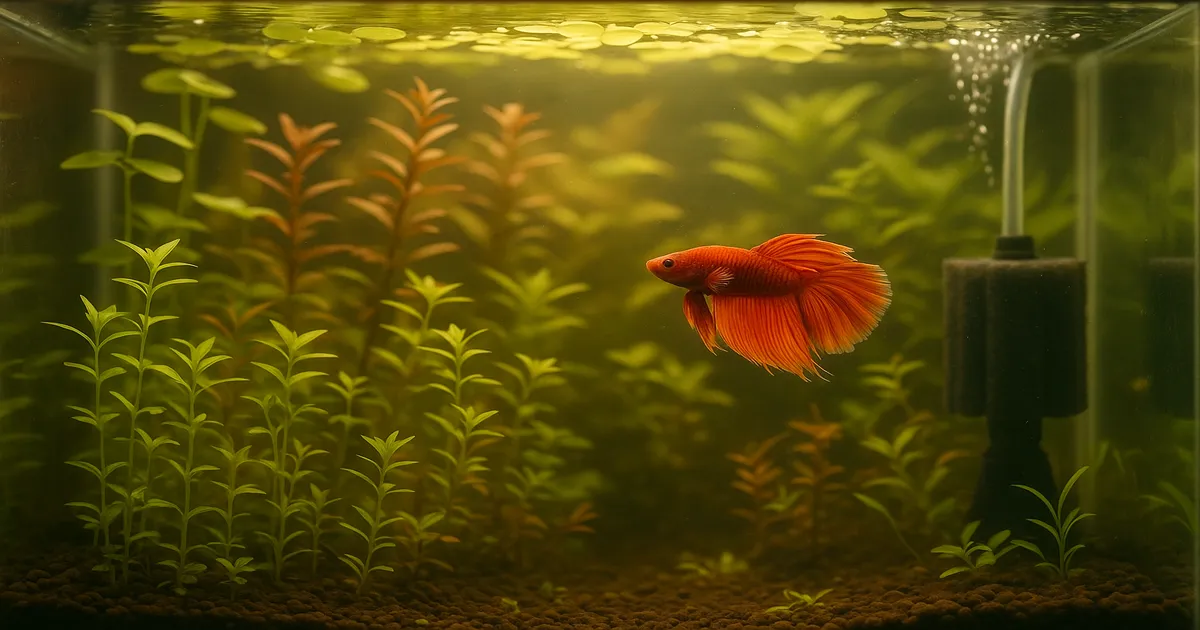
Quick Answer: Balancing flow and ferts in a betta tank means keeping water movement gentle and diffuse — targeting 3–5× turnover per hour — while dosing fertilizers conservatively enough to keep nitrates below 20 ppm. Use spray bars, baffled HOBs, or sponge filters to eliminate directed current, and lean on floating plants to absorb excess nutrients and buffer surface agitation. Because bettas breathe at the surface with their labyrinth organ, calm surface access isn’t optional — it’s non-negotiable.
Getting the balance right between flow and fertilization is one of the trickier parts of setting up a planted betta tank. Too much current and your betta is exhausted and stressed. Too little circulation and your plants stagnate, algae moves in, and nutrients pool unevenly. This guide walks through exactly how to balance flow and ferts in a betta tank — from choosing the right filter to dialing in your fertilizer routine without sending nitrates through the roof.
Why Bettas and Planted Tanks Are a Tricky Combination
Wild Betta splendens evolved in the rice paddies, floodplains, and sluggish streams of the Mekong River basin — places where water barely moves and dense vegetation covers the surface. That evolutionary history is baked into your betta’s biology, and it doesn’t disappear because you bought a fancy filter.
The labyrinth organ is the clearest example. Bettas breathe atmospheric oxygen directly at the water’s surface — a trait that evolved specifically because their native waters are often oxygen-depleted. Strong current that prevents calm surface access isn’t just uncomfortable; it’s a genuine health risk. Flow management is a welfare issue, not a preference.
Plants, on the other hand, need water movement to deliver CO₂ and dissolved nutrients to leaf surfaces and to prevent stagnant dead zones where algae thrive. A completely still tank might feel betta-friendly, but it creates nutrient pockets and poor gas exchange.
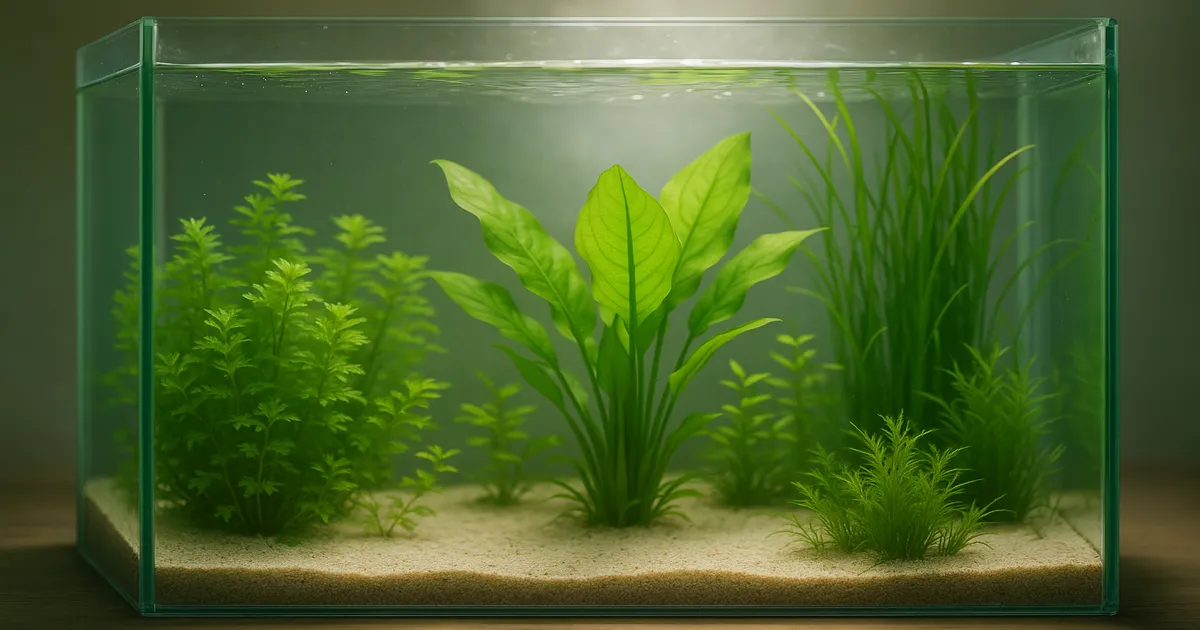
The solution isn’t to choose between your betta’s comfort and your plants’ health. It’s to replace directed current with diffuse circulation. A spray bar spreading gentle flow across the back wall, floating plants breaking up surface agitation, a dense stand of Java Fern deflecting current into eddies — these create movement without punishment.
How to Balance Flow and Ferts in a Betta Tank: Filter Selection
Sponge Filters
For tanks in the 5–10 gallon range, a sponge filter is hard to beat. Output is inherently gentle, biological filtration is excellent, and you can dial down the airflow with an adjustable valve on your air pump. There’s no directed outflow to stress your betta, and the sponge surface becomes a grazing zone for snails and microorganisms.
Hang-On-Back Filters
HOB filters are popular and capable, but their outflow can be surprisingly strong — especially in smaller tanks. The fix is a baffle. Attach a piece of filter sponge to the outflow nozzle to break up the stream and reduce velocity by 50–70%. Alternatively, angle the outflow to hit the glass wall directly rather than projecting across open water. Either approach transforms a betta-hostile current into something manageable.
Canister Filters
Canisters are the gold standard for tanks 20 gallons and up. The key is the outflow attachment. A spray bar positioned horizontally just below the surface spreads flow across a wide area with minimal point velocity. A lily pipe creates a gentle surface ripple without a directional push. Both work beautifully in planted betta tanks.
Target Turnover Rate
Aim for 3–5× tank volume per hour — so a 10-gallon tank needs roughly 30–50 GPH of actual flow. That’s well below the 10× turnover you’d run in a high-tech CO₂-injected planted tank, and it’s the sweet spot where plants get adequate circulation without your betta fighting the current.
Practical Flow Management Strategies
Spray Bars and Lily Pipes
A spray bar positioned just below the water surface, angled slightly downward or parallel to the back wall, distributes outflow across the entire tank length. Velocity at any single point drops dramatically. Lily pipes push water along the surface in a smooth sheet that creates a gentle ripple rather than a current. The right choice depends on your filter type and tank layout.
Floating Plants as Natural Flow Buffers
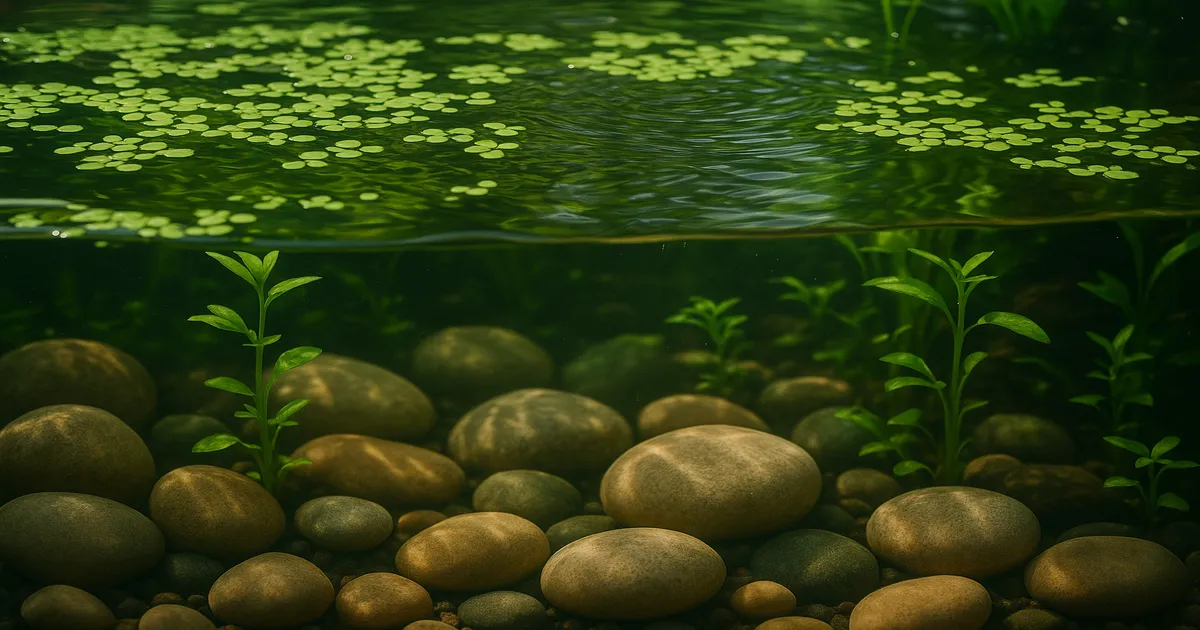
Floating plants are underrated in betta tanks. A layer of Salvinia minima, Frogbit, or Dwarf Water Lettuce breaks up surface agitation, absorbs nitrates and phosphates directly from the water column, provides shade your betta genuinely appreciates, and creates the calm surface zone the labyrinth organ needs. If you’re fighting surface turbulence, floating plants are often the simplest fix.
The Dual-Zone Design
Think of your tank in two halves. The filter outflow side handles circulation — water moves, plants get nutrients, CO₂ reaches leaf surfaces. The opposite side is your betta’s living room: minimal current, calm surface access, resting spots near the top. Dense masses of stem plants, Anubias clusters, and Java Fern stands naturally deflect and dissipate flow as water passes through them. Position driftwood and rocks to create pockets of slower water on the side opposite your filter outflow.
Reading Your Betta
Your betta will tell you if something’s wrong.
Signs of too much flow:
- Clamped fins pressed tight against the body
- Struggling to hold position or swimming at a constant angle
- Hiding near the bottom or behind equipment
- Rapid, labored gill movement
Signs of too little flow:
- Algae patches in corners and on slow-growing leaves
- Poor or stalled plant growth
- Murky, listless water
Long-finned varieties like Halfmoons and Rosetails are far more vulnerable than short-finned Plakats. If you’re keeping a heavily finned betta, err toward the gentler end of that 3–5× range.
Water Parameters for a Planted Betta Tank
| Parameter | Ideal Range |
|---|---|
| pH | 6.5–7.0 |
| GH | 3–8 dGH |
| KH | 2–5 dKH |
| Temperature | 78–82°F (25.5–27.8°C) |
| Ammonia | 0 ppm |
| Nitrite | 0 ppm |
| Nitrate | below 20 ppm |
KH deserves special attention. Bettas thrive in soft water, which typically means low KH — but KH is your tank’s pH buffer. The lower it is, the more vulnerable your water is to pH swings. CO₂ injection and liquid carbon both push pH downward, and in a low-KH tank that drop can be sharp and dangerous. If you’re seeing instability, nudge KH up to 3–4 dKH and consider monitoring with a reliable pH pen.
Stability matters more than hitting exact numbers. A betta living at a steady pH 7.1 will be healthier than one experiencing daily swings between 6.5 and 7.5.
Driftwood and Indian Almond Leaves release tannins and humic acids that gently lower pH, soften water, and have mild antibacterial properties. They also turn the water a warm amber color that mimics the betta’s natural habitat and visibly reduces stress behavior. One caveat: Seiryu stone gradually raises KH and pH, so test regularly if you’re using it. Aquasoil substrates like ADA Amazonia or Fluval Stratum naturally buffer toward pH 6.5–7.0, making them an excellent choice for betta planted tanks.
How to Balance Flow and Ferts in a Betta Tank: Fertilizing Safely
What Your Plants Actually Need
Plants need macronutrients (nitrogen, phosphorus, potassium) and micronutrients (iron, manganese, trace elements). In a betta tank, the fish itself provides a baseline of nitrogen and phosphorus through waste — which means you’re often supplementing micronutrients and potassium more than full NPK. Start lean and scale up based on what you observe.
Lean Dosing
The demand-driven approach works best: dose based on actual plant deficiency signs rather than a fixed schedule. Yellow leaves, stunted growth, or holes in older leaves signal a deficiency. No symptoms? Hold off. Excess nitrogen from over-dosing macronutrients raises nitrate and feeds algae — two problems a betta tank doesn’t need. A comprehensive liquid fertilizer dosed conservatively covers most planted betta tanks well.
Root Tabs vs. Water Column Dosing
Root tabs are ideal for substrate-feeding plants like Crypts and Amazon Swords — nutrients go directly into the substrate with minimal impact on the water column. Water column dosing with liquid fertilizers benefits epiphytes and floating plants that feed through their leaves. Using both strategically lets you feed your plants precisely without spiking nitrates in open water.
CO₂ and Liquid Carbon
Liquid carbon products like Seachem Flourish Excel suppress algae and provide a carbon source for plants. But glutaraldehyde is a biocide at high concentrations — never overdose, and be especially cautious in low-KH tanks. If you keep shrimp alongside your betta, note that liquid carbon can harm invertebrates even at label doses.
Full CO₂ injection is possible but adds complexity. It can drop pH by 0.5–1.5 units depending on KH. Use a drop checker, maintain KH at 3–4 dKH minimum, turn off CO₂ at night, and ensure gentle surface gas exchange for oxygenation. For most betta keepers, a low-tech planted tank with the right plant selection is a simpler and equally rewarding path.
Best Plants for a Low-Flow, Low-Fert Betta Tank
Epiphytes — Anubias and Java Fern: Attach to driftwood or rock (never bury the rhizome), tolerate low light, absorb nutrients from the water column, and genuinely don’t care about low flow. Their broad leaves give your betta natural resting spots near the surface. Bolbitis is another excellent option.
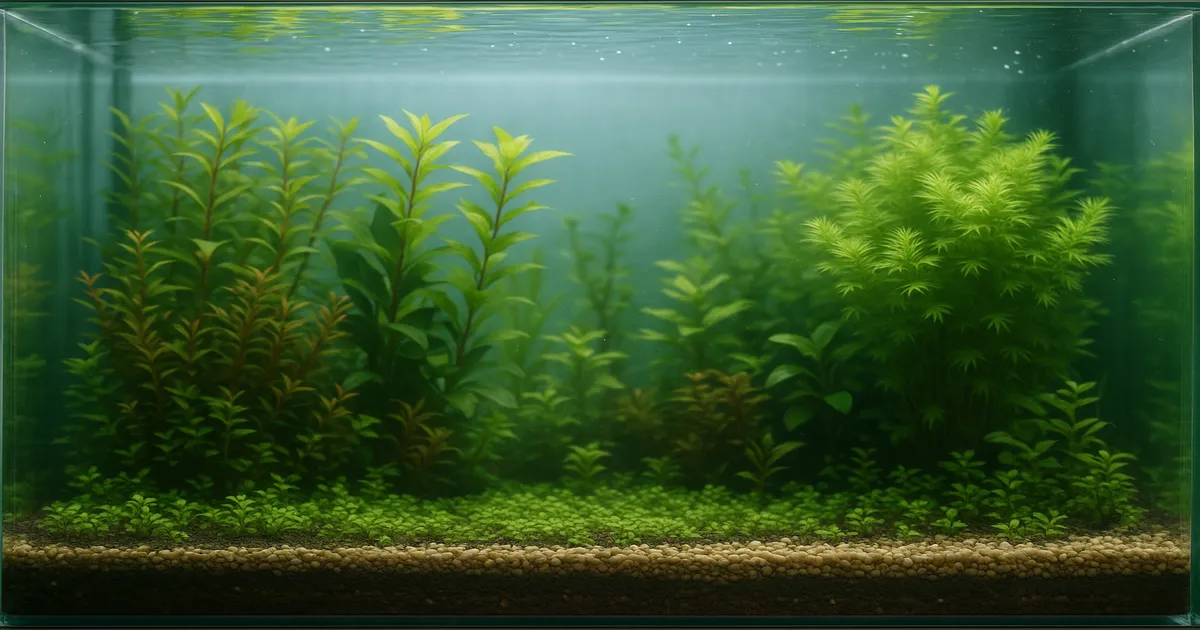
Crypts and Stem Plants: Cryptocorynes are slow-growing, root-feeding plants that thrive in aquasoil or with root tabs — nearly indestructible once established. Stem plants like Rotala, Bacopa, and Ludwigia grow faster, consume more nutrients, and actively compete with algae. They also create dense masses that deflect flow and give your betta places to explore.
Floating Plants: Salvinia minima, Frogbit, and Dwarf Water Lettuce absorb nitrates and phosphates directly, diffuse surface agitation, and create the sheltered surface environment bettas instinctively seek. They’re fast-growing nutrient sponges that help balance fertilizer overages. If you do nothing else from this guide, add floating plants.
Mosses: Java Moss and Christmas Moss attach to hardscape, break up directional flow, and create microhabitats for beneficial bacteria. Low-maintenance, low-nutrient, and your betta will spend time investigating them.
Feeding, Waste, and Keeping Nutrients in Check
Feed 2–4 high-quality pellets per feeding, twice daily. Everything should be consumed within 2–3 minutes. Good options include Northfin Betta Bits, Fluval Bug Bites Betta Formula, and New Life Spectrum Betta. Supplement with frozen Daphnia or Mysis shrimp a few times per week — Daphnia is particularly good for digestion. Fast your betta one day per week to reduce waste load and prevent constipation.
Every uneaten pellet that dissolves is an uncontrolled nutrient dump — ammonia first, then nitrate. In a planted tank where you’re carefully calibrating fertilizer inputs, overfeeding throws the entire system off. Precision feeding isn’t fussiness; it’s part of the system.
Test ammonia, nitrite, nitrate, and pH weekly with a reliable liquid test kit. If nitrate approaches 20 ppm, do a 20–30% water change. A well-planted tank with lean feeding may stretch longer between changes — but never skip testing. Parameters drift quietly, and bettas don’t always show stress until it’s advanced.
Common Problems and How to Fix Them
Fin Rot: Often a two-factor problem — flow stress weakens the immune system, and poor water quality provides the bacterial opportunity. Address flow first, then confirm water quality: 0 ppm ammonia, 0 ppm nitrite, nitrate below 20 ppm. Mild cases sometimes resolve with improved water quality alone. Active infections respond well to Seachem Kanaplex or Maracyn.
Algae Outbreaks: Diagnose before treating. Green spot algae on slow-growing leaves usually means too much light and insufficient nutrients. Hair algae and staghorn suggest excess nutrients and inconsistent CO₂. Black beard algae loves low-flow dead zones — reposition your outflow to eliminate stagnant corners and add floating plants to absorb excess nutrients. Keep your photoperiod to 8–10 hours on a consistent timer.
pH Swings: Check KH first. Below 3 dKH, even modest CO₂ injection can cause dangerous swings. Reduce injection rate, raise KH slightly with baking soda or a commercial KH buffer, or use a drop checker targeting green (approximately pH 6.8–7.0). Never let pH drop below 6.0 in a betta tank.
Lethargy or Clamped Fins: Test parameters first. If ammonia, nitrite, and nitrate are all in range, assess flow — is your betta swimming effortlessly with fins held naturally, or struggling to maintain position? Provide a calm resting zone near the surface and observe for 24–48 hours after any adjustment. If parameters are off, do a partial water change immediately and dose a quality water conditioner to neutralize chlorine and chloramines. (Seachem Prime)
Frequently Asked Questions
What flow rate is safe for a betta fish in a planted tank?
Target 3–5× tank volume per hour. For a 10-gallon tank, that’s 30–50 GPH of actual output. Spread that flow with a spray bar or baffled outflow so no single point creates a strong current. Long-finned bettas like Halfmoons need the lower end of that range; short-finned Plakats tolerate slightly more.
Can I use CO₂ injection in a betta tank?
Yes, but carefully. CO₂ can drop pH by 0.5–1.5 units — manageable with a KH of 3–4 dKH and a drop checker, dangerous without monitoring. Turn CO₂ off at night, maintain gentle surface gas exchange, and never let pH fall below 6.0. For most betta keepers, a low-tech planted tank is simpler and equally rewarding.
How often should I fertilize a planted betta tank?
Dose based on plant deficiency signs, not a fixed schedule. Bettas provide nitrogen and phosphorus through waste, so you’re usually supplementing micronutrients and potassium. Start with half the recommended dose of a comprehensive liquid fertilizer and adjust upward only if you see yellowing or stunted growth. Test nitrates weekly to confirm you’re not overloading the system.
Do floating plants really make a difference in a betta tank?
Yes — significantly. Floating plants like Frogbit, Salvinia, and Dwarf Water Lettuce absorb nitrates and phosphates directly, break up surface agitation, provide shade, and create the calm surface zone bettas need for their labyrinth organ. They’re also fast-growing, which means they actively compete with algae for nutrients. They’re the single highest-impact addition for most betta planted tanks.
Why does my betta hide near the bottom even with low flow?
Bottom-hiding can indicate flow stress, poor water quality, illness, or inadequate hiding spots. Test parameters first — ammonia and nitrite should be 0 ppm, nitrate below 20 ppm. If parameters are fine, check for directed current near the bottom of the tank and add resting spots like broad-leaved Anubias or driftwood near the surface. If hiding persists after flow and water quality are addressed, look for signs of illness such as clamped fins, white spots, or bloating.